Crop Products

Products should earn their place in the program.

Pleasant View AG shares the crop products we use, what problem each one is meant to address, and where we believe it fits. The goal is not a shelf full of claims. It is a practical program that makes sense on the acre.

Farmer-operatedBuilt from how we evaluate products on our own operation.
Real field evidenceOur photos and notes are separated from product claims.
Hitchcock, South DakotaLocal conversations and practical application context.
Program firstStart with the problem and current program, not the jug.

Pleasant View AG

Canopy Product Line

We think about Canopy as a program with different jobs, not four interchangeable products. Final Typical Analysis, rates, placement and application guidance stay tied to current approved product documentation.

Soil & fertilityFoundation

The humic-focused part of the program.

AvailabilityAbsorb

The fulvic-focused component.

NutritionRecharge

The nutrient-focused component.

Crop supportCandy

The crop-sugar component.

Foundation
Canopy program

Foundation

The humic-focused part of the Canopy program, built around the soil and fertility side of the system rather than being treated as a standalone silver bullet.

Current label, Typical Analysis and use guidance control final rate and application details.
Absorb
Canopy program

Absorb

The fulvic-focused component of the Canopy program, positioned around nutrient availability and practical integration into a fertility program.

Current label, Typical Analysis and use guidance control final rate and application details.
ReCharge
Canopy program

ReCharge

The nutrient-focused Canopy product in the program. Exact Typical Analysis and recommended fit will stay tied to approved product documentation.

Current label, Typical Analysis and use guidance control final rate and application details.
Candy
Canopy program

Candy

The crop-sugar component of the Canopy line. We pair the product information with our own field observations where we have them.

Current label, Typical Analysis and use guidance control final rate and application details.

Why we built this page differently

We don’t sell products we haven’t thought through.

Not every product belongs on every acre. We would rather understand what you are trying to improve, how the product fits the rest of the program, and what the current label supports than pretend one jug is the answer to everything.

What it does

We explain the intended role in plain language and keep technical details tied to current documentation.

Where it fits

We look at crop, timing, equipment, fertility or spray pass, water and the rest of the program.

What we have seen

Our photos and notes are field observations, not guaranteed outcomes.

When to skip it

If the problem is not there or the product does not fit, another input is not automatically better.

Beyond Canopy

Other Crop Products We Use and Believe In

These products have specific jobs in the program. Where we have personally used a product, we say so. Technical claims stay tied to current manufacturer and product documentation.

NutriCharge EEP Liquid
Used on our operation

Phosphorus availability

NutriCharge EEP Liquid

NutriCharge is positioned around keeping applied phosphorus available and helping release phosphorus already tied up in the soil. We also have our own in-furrow comparison below.

Why it is here: we have used NutriCharge Liquid ourselves and have real field notes and root comparisons to show alongside manufacturer information.

Reclaim crop residue product
Used on our operation

Crop residue

Reclaim

Reclaim is a biological residue-management product positioned around residue breakdown, nutrient release and the soil environment going into the next crop.

Our use: we have used Reclaim for roughly three seasons and plan to use it again this fall. We will add more of our own observations when the current farm notes are compiled.

ReadyWater concentrated spray water conditioner
Used on our operation

Hard water & loading

ReadyWater

ReadyWater is a concentrated spray-water conditioner designed to address hard-water antagonism and serve as an alternative to dry AMS where product and tank-mix labels support that use.

Our use: ReadyWater replaced bagged AMS in our program this season. We did not throw a single bag of AMS, and the handling simplification was a major reason we liked it.

NutriCharge PowerPlant
Used on our operation

Planter-box efficiency

NutriCharge PowerPlant

PowerPlant is a dry planter-box treatment that combines seed lubrication with NutriCharge chemistry and biological / micronutrient components.

Our use: we have used the standard PowerPlant product. Exact crop rates and analysis stay tied to the current technical sheet rather than becoming a blanket recommendation.

NutriCharge TriPhase phosphorus management product
Technical option

Phosphorus management

NutriCharge TriPhase

TriPhase is another NutriCharge formulation positioned around protecting applied phosphorus while helping release soil and mineral phosphorus reserves.

Why it is listed differently: we have technical information for TriPhase, but are not labeling it “used on our operation” until we confirm exactly which TriPhase versions were used.

Technical library

Read the product information, not just the marketing.

We are building this library around current labels, technical sheets and manufacturer resources. Our own observations are kept separate so it is clear what came from our farm.

Planning tool

Acreage Calculator

Once you know the correct label-approved rate for your situation, use this calculator to estimate total product and container count. It does not recommend a rate.

Total product0 fl oz
Total gallons0 gal
Whole containers0

Always read and follow current product and tank-mix partner labels. Container estimate rounds up.

How Pleasant View AG approaches it

Fit first. Claims second.

Start with the problem

Crop, acres, fertility, water, timing, equipment and what you already do all matter.

Use current documentation

Rates, compatibility, safety and application details come from current labels and resources.

Separate evidence from guarantees

Our farm observations are useful context, not a promise another field will respond the same way.

From our own fields

Field Comparison

2026 Plant DigPleasant View AG

Actual field photos from the same comparison.

Pleasant View AG field comparison photo
Full Plant side x sideStarter vs NutriCharge/Candy/Foundation
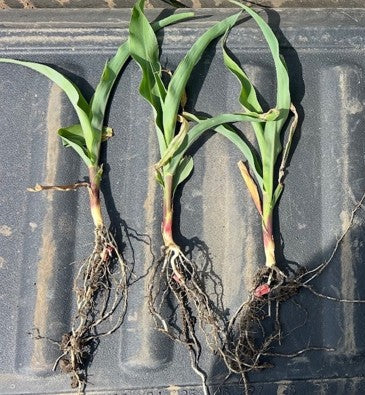
Starter PlantSmaller stalk, less brace roots, and smaller root system.
NutriCharge, Candy, Foundation PlantThicker stalk, more brace roots, and thicker longer root system.
Pleasant View AG comparison or check photo
Root ComparisonStarter vs NutriCharge/Candy/Foundation
Root DifferenceSignificant difference in root size, brace roots, stalk size, and overall length of roots between the two.
Observed difference

The plant/roots on the left got typical starter (6-26-6), Zinc, and Diverse K @ 5 gal/acre. It cost aprox. $36/acre to apply and we saw a smaller stalk, a much smaller root system, and less brace roots. The plant/roots on the right got NutriCharge, Canopy Candy, Canopy Foundation and a carrier of 4 gal/acre of water. It cost aprox. $15/acre to apply and we saw a much thicker stalk, longer thicker roots, and additional brace roots.

Field notes / context

Dug up from the same field, at the same time, and planted in the same day.

Field observation: Photos and notes are from our own operation. They show what we observed under those conditions and are not a guarantee of the same response in other fields. Follow current product labels and applicable tank-mix partner labels.

What to notice

1
Starter Plant

Smaller stalk, less brace roots, and smaller root system.

2
NutriCharge, Candy, Foundation Plant

Thicker stalk, more brace roots, and thicker longer root system.

3
Root Difference

Significant difference in root size, brace roots, stalk size, and overall length of roots between the two.

Plant Dig June 22, 2026Pleasant View AG
Pleasant View AG field comparison photo
Nothing | Check
NutriCharge/Candy/ Foundation
MyycoMaxx
Starter
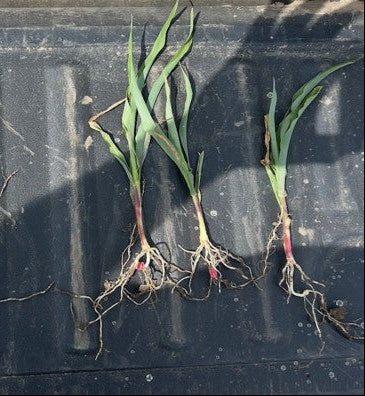
Check PlantThis plant had nothing applied in-furrow.
Starter Plant5 gal/acre 6-26-6, 32oz Zinc, 32oz Diverse K applied in-furrow.
MyycoMaxx PlantMyycoMaxx applied in-furrow by itself.
NutriCharge, Candy, Foundation Plant6.4oz NutriCharge, 32oz Canopy Candy, 16oz Canopy Foundation, and 4 gal/acre water.
Observed difference

this was a documented comparison with a check and multiple fertility / biological treatments. The photos are presented as field observations rather than a promise that every field will respond the same way.

Field notes / context

All dug up the same day, planted the same day just hours apart.

Field observation: Photos and notes are from our own operation. They show what we observed under those conditions and are not a guarantee of the same response in other fields. Follow current product labels and applicable tank-mix partner labels.

What to notice

1
Check Plant

This plant had nothing applied in-furrow.

2
Starter Plant

5 gal/acre 6-26-6, 32oz Zinc, 32oz Diverse K applied in-furrow.

3
MyycoMaxx Plant

MyycoMaxx applied in-furrow by itself.

4
NutriCharge, Candy, Foundation Plant

6.4oz NutriCharge, 32oz Canopy Candy, 16oz Canopy Foundation, and 4 gal/acre water.

From our own fields

Field Evidence

Real Pleasant View AG photosReal field notesObservations, not guarantees

We would rather show what we actually saw than build a page around generic claims. These photos came from our own field work and are paired with the notes recorded with those comparisons.

1

Plant Dig 2026

We pulled plants and compared the above-ground crop and root systems. The photos below are the actual plant-dig images from that field-work set.

What the notes support: The NutriCharge Plants were much thicker, taller, healthier, with much more of a root system. Both planted in the same field/day.

nutricharge comparison
Water Check comparison

Right IMage 6.4oz nutricharge / left image water check

  • 6.4 oz NutriCharge
  • Water In-furrow Check
2

Two Days After Flexstar

These soybean photos were documented two days after a Flexstar application as part of our recovery observations.

What the field notes say: the recovery-pass notes reference Canopy Candy with the Canopy Absorb product; We are showing the photos and the timing exactly as a field observation, not claiming the photos prove a guaranteed response.

2 days after application
Field recovery observation
3

NutriCharge In-Furrow Comparison

This comparison set came from the same Pleasant View AG field-work archive and focuses on early corn and root development.

What the notes support: the documented comparison includes a water in-furrow check, a 6.4 oz NutriCharge treatment and MycoMaxx.

Corn comparison
Corn comparison
Root comparison
Root comparison

Comparison labels in the source notes

  • Water in-furrow check
  • 6.4 oz NutriCharge
  • MycoMaxx
How to read these photos

These are real observations from our operation. Results can vary with environment, timing, rate, fertility, crop condition, water quality and other management factors. Current product labels and tank-mix partner labels control actual use.

Want to talk through your own program?
Tell us what you are trying to solve and what you are already doing on the acre.

Contact Pleasant View AG

Next step

Know what you need, or want help building the program?

Either way, start with Pleasant View AG. If you already know the product and quantity, ask for pricing. If you are still deciding what fits, tell us about the acres and what you are trying to improve.

Help Me Build a Program

We do not need a perfect agronomy report to start. Give us the basics and what you want to improve.

Any product-use discussion still needs to follow current product labels and applicable tank-mix partner labels.